Will Filing a New VA Claim Reduce My Existing Ratings? What the Law Actually Says
Claims Strategy · Apr 24, 2026 · Chris Combs · 15 min
Veterans ask this question every week. You have a service-connected condition rated 30%, 50%, sometimes higher. It took years to get. You've learned to live with VA's bureaucracy, and now a new condition has emerged -- sleep apnea, hypertension, a back problem, tinnitus. You know you should file. You've read that secondary claims and presumptives are winnable. But then the voice in your head says: what if they look at my whole file, decide I'm 'improved,' and reduce the rating I already have?
That fear is the single biggest reason legitimate claims sit unfiled. It's also mostly wrong -- but not entirely. Here's what the law actually says, what BVA decisions from the past year actually show, and how to tell the genuinely low-risk claims from the ones that deserve more caution. No hedging. Specific citations. Direct answers.
The Fear, And What Part of It Is Real
The specific fear is usually phrased like this: 'If I file for Condition X, won't VA pull my whole file and reduce Condition Y?' I searched the 2024-2025 BVA case stream for exactly this scenario -- a new claim for one condition causing reduction of an unrelated condition -- and could not find a single example. The top-ranked hits using 'unrelated' + 'reduction' + 'new claim' all use 'unrelated' in the medical-etiology sense ('the Veteran's kidney disorder was unrelated to service'), not the procedural sense. The spontaneous-rater-reopens-your-PTSD-because-you-filed-for-tinnitus scenario is, in the actual case data, folklore.
What IS real is narrower: filing an increase claim for Condition X triggers a new C&P exam, and that exam can produce findings VA uses to propose reducing Condition X. The scary scenario is real -- but it attaches to the condition you asked to increase, not to unrelated ratings. And even there, the Board reverses these reductions with high regularity on procedural, evidentiary, and substantive grounds. The rest of this post is about those protections.
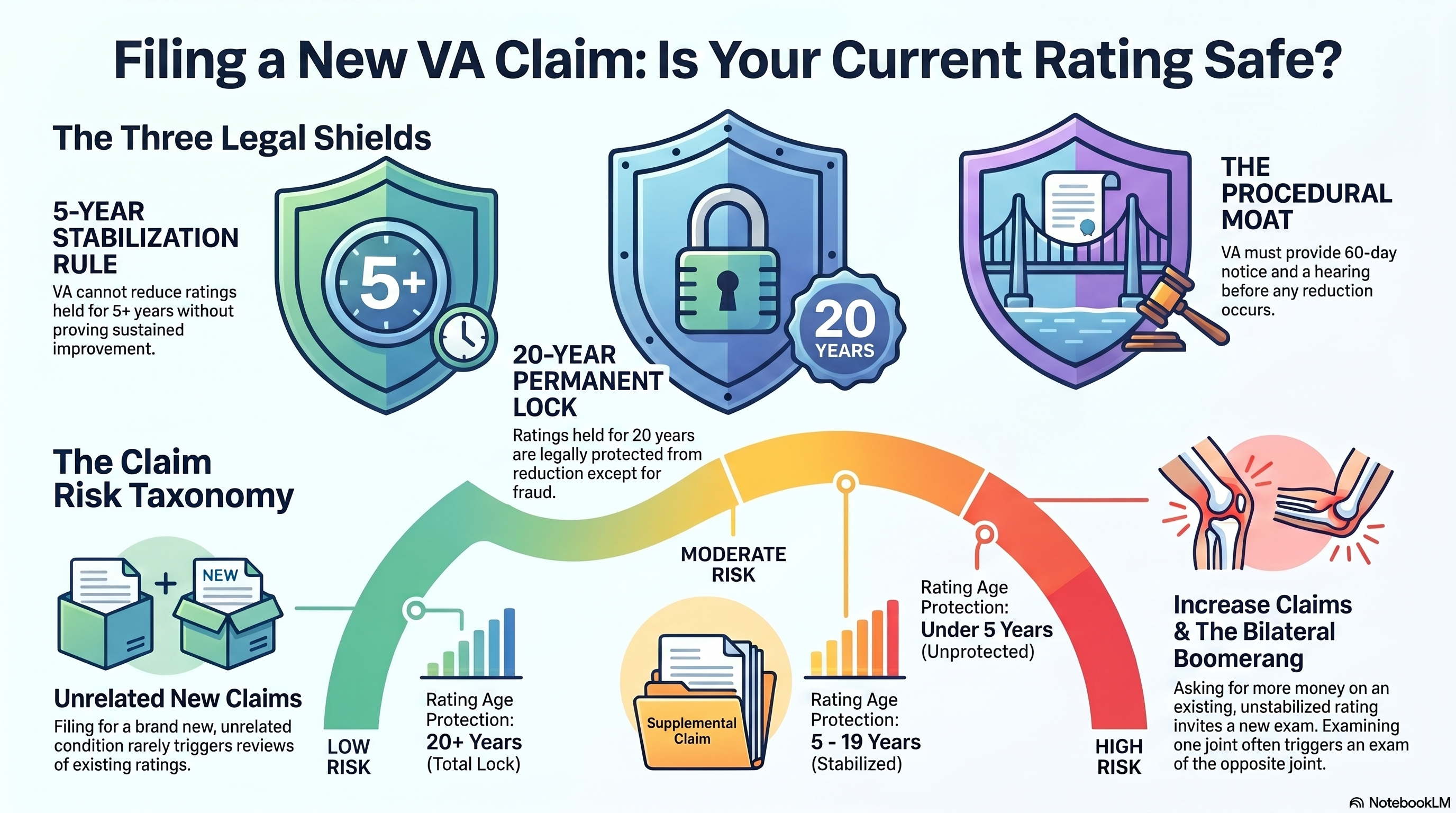
The Four Rules That Protect Your Existing Ratings
VA rating reductions are governed by a tight set of regulations. If you understand these four, you understand most of the protections that apply when you file a new claim.
Rule 1: 38 CFR 3.344 -- The 5-Year Stabilization Rule
This is the workhorse protection. If your rating has been at the same level for 5 or more years, it's considered stabilized, and VA has to clear three high bars to reduce it:
- The reduction cannot be based on a single examination. The reg says ratings 'will not be reduced on any one examination, except in those instances where all the evidence of record clearly warrants the conclusion that sustained improvement has been demonstrated.'
- VA must find actual, material improvement -- not a one-bad-day reading.
- VA must further find that the improvement 'will be maintained under the ordinary conditions of life' and work.
If any of those three fail, the reduction is improper. The CAVC in Brown v. Brown, 5 Vet. App. 413 (1993), articulated the standard directly: 'VA cannot reduce a veteran's disability evaluation without first finding... that an improvement has actually occurred in the veteran's service-connected disability, and it has improved to the point that he or she is now better able to function under the ordinary conditions of life and work.' And under Lehman v. Derwinski, 1 Vet. App. 339 (1991), a reduction that fails to apply 3.344 where applicable is 'void ab initio' -- meaning void from the start, rating restored.
The catch is in 3.344(c): these heightened protections apply to ratings 'which have continued for long periods at the same level (5 years or more).' For ratings under 5 years, a single thorough exam showing improvement can suffice. Which means the 5-year anniversary of your current rating level is a meaningful milestone.
The 5-year clock runs from the effective date of the current rating level to the effective date of any reduction. Each step-up increase (30 to 50, 50 to 70) can restart the clock for the upper portion. But M21-1 X.ii.4.A.2.d extends protection downward: if VA wants to reduce BELOW a formerly-stabilized lower level, the 3.344 protections apply at that lower level.
Rule 2: 38 CFR 3.951(b) -- The 20-Year Lock
If your rating has been 'continuously rated at or above any evaluation of disability for 20 or more years,' it 'will not be reduced to less than such evaluation except upon a showing that such rating was based on fraud.'
That's it. After 20 years, the evaluation is locked in at that minimum. VA cannot reduce it on a bad exam, on new medical findings, on a new claim you filed, on any basis short of proving you committed fraud to get the rating in the first place.
This is the strongest protection in the entire framework. In BVA case A25013152 (2025), the Board wrote: 'Under 38 C.F.R. § 3.951(b), that 10 percent [left knee instability] rating became protected, and without any evidence suggesting fraud, even with evidence of improvement in his ability to function under the ordinary conditions of life and work, the VA was prohibited from reducing the disability rating.' In A24021586, ratings dating to March 1996 were 'legally "protected" from reduction because the awards are considered to have been in effect for more than 20 years.' Same pattern in 25009527 (DJD since 1993) and A25034798 (60 percent asthma since January 1996).
Rule 3: 38 CFR 3.957 -- The 10-Year Service Connection Shield
Similar principle, different target. After 10 continuous years of service connection, VA cannot sever the service connection itself except for fraud or proof of disqualifying service. This protects the grant of SC, not the percentage. A 15-year-old SC'd condition rated 30% can, in theory, have its percentage adjusted -- but the underlying service connection status is locked.
Combined with the 20-year rule: a service-connected condition that's been at 30% for 20+ years cannot be severed (3.957) and cannot drop below 30% (3.951(b)). The shields stack.
Rule 4: 38 CFR 3.105(e) -- The Procedural Moat
Before VA can reduce any rating, they must:
- Issue a rating proposing the reduction, setting forth the material facts and reasons
- Notify you that you have 60 days to submit evidence that reduction is not warranted
- Notify you of your right to a predetermination hearing, requested within 30 days
- If you request the hearing, payments stay at the current level until a final determination
- After the final rating decision, wait another 60 days before payment actually drops -- the effective date is 'the last day of the month in which a 60-day period from the date of issue of the beneficiary's reduction notice expires'
Skip any of those steps, and the reduction is void. The Board in A25044982 (July 2025) wrote out the full four-step recitation verbatim and restored the rating when the RO collapsed proposal and implementation into a single decision. Same pattern in A25054218. In A24050621, TBI residuals reduced from 40% to 10% were restored because 'the record does not show that the Veteran was notified that he had any period of time within which to submit additional evidence showing that the reduction should not be made, or within which to request a predetermination hearing.' And in A25091100, the Board cited Greyzck v. West, 12 Vet. App. 288 (1999), for the void-ab-initio rule: 'Where a rating reduction was made without observance of law, the erroneous reduction must be vacated, and the prior rating restored.'
Procedural-notice violations are among the most common grounds for restoration at the Board. VA routinely skips these steps. Veterans and their reps routinely win on them.
What the BVA Data Actually Shows
I pulled 2024-2025 BVA decisions on reductions. A few patterns emerged clearly.
The 'unrelated condition reduced after new claim' scenario does not appear. I searched with multiple query variations -- 'new claim' with 'reduction' with 'unrelated,' and variants. Zero results where a vet filed for Condition X and VA reduced Condition Y as a collateral consequence. That specific fear appears to be folklore.
The real risk pattern is the increase-claim boomerang. You file for an increase, VA orders a new C&P for the condition, the examiner documents 'improvement,' and VA proposes reducing the same condition. This does happen. In A25068826 (2025), a veteran filed a supplemental claim for higher ratings; 'After a VA examination, the AOJ effectuated a rating reduction backdated to the examination evincing improvement.' But the Board reversed, because the examiner ignored a documented recurrent-infection history: 'upholding this rating reduction would be based upon an inaccurate factual premise.' In A25007919 (2025), a 30% carpal tunnel rating was reduced to 10% on a routine exam. Reduction vacated: 'The September 2022 rating decision did not address whether there was improvement in the Veteran's ability to function under the ordinary conditions of life and work.'
VA-scheduled reexaminations are the dominant trigger in the actual data, not veteran-filed claims. In 24004870, the Board couldn't find record justification for why a reexam was even scheduled: 'silence in the record as to what unusual circumstances required the scheduling of a new cardiovascular examination.' In A25062959, a 60% back rating was reduced to 0% based on failure to report to a VA reexamination -- restored on good-cause showing.
The single-exam rule under 3.344(a) gets applied aggressively. In A25087045 (October 2025), asthma was reduced from 60% to 30% after 7 years on a single exam. Board quoted Stern v. McDonough, 34 Vet. App. 51 (2021): 'As the AOJ effectuated the reduction of a rating that had been in effect for more than five years based on a single examination, and because the AOJ did not consider whether the evidence made it reasonably certain that the improvement would be maintained under the ordinary conditions of life, reinstatement of the 60 percent rating is required.' Same formula in A25098801 and A25110866.
The 'ordinary conditions of life and work' standard is where most reductions die. In A25051843 (2025), a 70% PTSD rating was reduced to 50%. Board: 'The decision to reduce the benefit was not in accordance with the law, in part because the RO failed to make a finding that the July 2020 examination used as a basis for the reduction was full and complete. Furthermore, there were no findings that it was reasonably certain that any material improvement found would be maintained under the ordinary conditions of life and work.' Rating restored, citing Kitchens v. Brown, 7 Vet. App. 320 (1995) and Brown again. This framework applies even to ratings under 5 years -- the single-exam bar relaxes under 3.344(c), but the ability-to-function standard still holds.
From BVA A25109251 (2025): a 50% migraines rating under 5 years old was reduced to 30%. The Board restored it because 'the evidence did not show improvement in the migraine disability, absent the ameliorating effects of medication, including under the ordinary conditions of life and work.'
Important caveat on the data. These are Board-level cases, which means they skew toward appeals the Board reviewed and reversed. That selection bias does NOT tell us how many reductions were never appealed, or were sustained at the Board, or never happened at all. What it does tell us is that when a reduction is flawed procedurally, evidentially, or substantively, the Board has a reliable, citable pattern of reversing it -- and VA fails those tests often enough that the flaws are common.
The Claim Risk Taxonomy
Here's how M21-1 and the case patterns sort out by risk tier. This is the section to read before you decide whether to file.
Low risk: file with confidence
- A brand new claim for an unrelated body system. You're SC for tinnitus; you file for sleep apnea. M21-1 V.ii.3.A.1.g explicitly warns raters against 'sympathetic reading' that 'misconstrues or makes generalized assumptions.' The C&P exam for the new condition shouldn't touch unrelated SC ratings. And M21-1 IV.ii.1.A.1.e addresses the exact scenario -- 'review in connection with an unrelated claim or issue' that reveals a pending future-exam control for a Veteran 55 or older -- by instructing raters to cancel the reexam. The policy direction points the opposite way from the fear.
- Secondary service connection claims. The exam focuses on causation or aggravation of the new condition. It doesn't reopen the primary rating unless you explicitly ask for an increase.
- Intent to File alone. No claim, no exam, no risk. If you're still gathering evidence, an ITF preserves the effective date without firing any exam trigger.
- Any claim where your existing rating is protected. If you're at 20+ years on the condition you're worried about, 3.951(b) locks it. If you're at a 100% schedular or permanent and total, 3.343 requires 'material improvement in physical or mental condition' and for TDIU 'clear and convincing evidence of actual employability' -- extremely high bars.
Moderate risk: file with attention
- Supplemental claim bringing the same body system under exam scope. A supplemental on a knee may produce a knee exam that documents the other knee -- especially in paired body parts. Review your evidence before filing and front-load a private medical opinion so the rater doesn't need to order a sweeping C&P.
- Higher-Level Review. No new exam, technically low risk, but the reviewer can surface CUE as a 'compensation entitlement issue' per M21-1 V.ii.3.A.1.f. If your original grant was borderline, HLR is where a quiet re-read happens.
- TDIU claim while working part-time. This one is a trap. TDIU triggers a hard look at substantially gainful employment. If you've returned to even part-time work and file for TDIU, the employment evidence you submit can be used to reduce an existing TDIU or 100% schedular under 3.343. Don't file TDIU while working without talking to a VSO or accredited rep first.
Higher risk: file with eyes open
- Increase claim for an existing rating less than 5 years old. A thorough single C&P exam plus 60-day procedural notice can support a reduction (3.344(c), M21-1 X.ii.4.A.1). The 3.344(a) single-exam bar doesn't apply yet.
- Increase claim for a paired or bilateral body part. M21-1 V.ii.3.A.1.f gives the textbook example: veteran claims increase for the left knee, C&P orders a bilateral knee exam, examiner documents improvement in the right knee (30% for 3 years), rater proposes reducing the right knee. This is cited as proper rater procedure. Paired body parts -- knees, ears, hands, shoulders -- are exposed on bilateral exams.
- Increase claim within the 5-year unstabilized window. Combine the first two risks and the exposure is real.
- Reopening a previously denied claim that brings the same body system under fresh review. If you have an unprotected rating in that system, the exam scope can pull it in.
If your target increase sits in the higher-risk tier, seriously consider whether the expected rating bump is worth the exposure. A 10% to 20% move for a condition that might get reduced to 0% instead is a bad trade. A 40% to 60% move for a condition that's been stable at 40% for 15 years and is genuinely worse -- different calculus.
Five Moves to Reduce Your Exposure
Regardless of tier, these five moves protect you.
1. Front-load private medical evidence
Under 38 CFR 3.326(b), a private medical opinion can satisfy VA's exam requirement if it's thorough. Submit a detailed private DBQ or treating-provider opinion with the claim so the rater has what they need without ordering a sweeping C&P. If VA still orders an exam, it's narrower in scope because the private evidence already does the work.
2. Use an Intent to File to buy time
Filing an ITF preserves your effective date for up to a year while you gather evidence. No exam fires on an ITF alone. If your evidence isn't ready, don't file a formal claim prematurely.
3. Check your rating age before any increase claim
Pull your rating history. If the condition you want to increase has been at its current level for 5+ years, you're in the 3.344(a) protection zone. If it's been less than 5 years, you're in the easier-to-reduce zone. Knowing which zone you're in changes the strategy.
4. Never combine TDIU with active employment evidence
If you're working at any level, talk to an accredited representative before filing TDIU. The employment evidence you'd need to submit can boomerang on an existing 100% rating under 3.343.
5. If VA proposes a reduction, do three things fast
- Request the predetermination hearing within 30 days. Payments stay at the current level until the final decision.
- Submit evidence within the 60-day window showing why reduction is not warranted -- treatment records, private medical opinion, lay statements about functional impact under ordinary conditions of life and work.
- If VA skipped any step -- no proposal letter, no hearing offer, no 60-day window -- document it immediately. Procedural violations make the reduction void ab initio under Greyzck and Lehman.
The Predetermination Hearing in Practice
The predetermination hearing is the single most undervalued tool in this entire framework. Under 38 CFR 3.105(i)(1), the request must arrive within 30 days of the proposal notice -- not 60, not 'within the response window.' Thirty. Day 31 and the right is gone.
If you make that deadline, two things lock in. First, your payments stay at the current rate until the rating specialist issues a final decision after the hearing -- not just until the hearing is scheduled, and not just through the 60-day response window. Second, the adverse action proposal period automatically extends to accommodate the hearing. The governing procedure lives at M21-1 Part X, Subpart ii, Chapter 3, Section B (last updated December 2025), which instructs raters: 'If a hearing is requested within the applicable time limit... do not take final action on the proposed adverse action until the hearing is properly completed, or the right to a hearing is otherwise discharged.'
How long until the hearing actually gets scheduled. VA does not publish hard turnaround times for predetermination hearings, and the M21-1 does not impose a specific statutory deadline -- it requires 'timely scheduling' and cross-references M21-1 Part X, Subpart v, Chapter 1, Section D for the RO hearing procedures. Realistically, predetermination hearings land 30 to 90 days from the request depending on the regional office's workload. A few ROs run quicker; some run longer. Phone and video slots tend to open faster than in-person. End-to-end -- from the proposal notice to a final decision with a hearing in between -- typically runs four to eight months. Every one of those months your payments stay at the pre-reduction level, and every one of those months is time to strengthen the record.
What happens at the hearing itself. It is conducted by a Decision Review Officer (DRO) or rating specialist, usually by phone or video -- in-person is available but no longer the default at most ROs. It is not adversarial. You are entitled to bring a representative: VSO, accredited agent, or attorney. The real value is not just delay. The hearing is a live opportunity to submit evidence the examiner never saw, correct factual errors in the C&P report, and testify directly about functional impact 'under ordinary conditions of life and work' -- the exact standard Brown and Kitchens require VA to address before any reduction can stand. Many reductions that looked final on paper get walked back here because the veteran showed up with a private medical opinion, a spouse's lay statement, or a treatment record the examiner did not have.
Good cause if you miss. If you cannot attend the scheduled hearing, 38 CFR 3.105(i) and M21-1 X.ii.3.B.3.e require VA to reschedule on a priority basis when good cause is shown (illness, family emergency, transportation failure, military duty). But document the good cause in writing before or immediately after the missed date -- communications after VA issues the final decision must be paired with a formal decision-review election.
The day a proposed reduction letter arrives, do three things same-day: (1) write a one-paragraph letter requesting a predetermination hearing and upload it through VA.gov or fax it with proof of transmission, (2) start gathering a private medical opinion addressing functional impact under ordinary conditions of life and work, (3) draft lay statements from people who see you live with the condition. Requesting the hearing buys you four to eight months at current-level payments -- and that window is when you build the evidence that gets the proposed reduction reversed.
The Bottom Line
The fear that filing a new claim causes VA to pull your file and reduce unrelated ratings is mostly wrong. M21-1 doesn't authorize it. The 2024-2025 BVA case stream doesn't contain examples of it. Reducing a rating requires evidence of improvement in that specific condition, procedural notice, and in most cases a new examination -- none of which are triggered by a genuinely unrelated new-condition claim.
The real risks are narrower and more predictable: increase claims, bilateral-body-part exams, ratings under 5 years old, and TDIU-while-working claims. Each of those has a clear legal framework. Each gets aggressively protected when VA gets procedure wrong. And ratings over 20 years are statutorily untouchable absent fraud.
The worst outcome isn't 'I filed and got reduced.' The worst outcome is 'I didn't file a legitimate claim I was entitled to because I was afraid of something that wasn't going to happen anyway.' Know which tier your claim is in, front-load your evidence, and file.
If you have a genuinely unrelated new condition, the question isn't whether to file -- it's when to file. Preserve your effective date with an Intent to File, gather private evidence, and submit. The 'unrelated claim triggers reduction of my existing rating' scenario is not a pattern in the BVA data. The 'I waited five years to file because I was scared, and now my effective date is five years shorter' scenario is in every BVA data set.